 Skip to content

Published by Dan Cahill· April 2026 · Commercial Roofing | Southern California
It’s a scenario that plays out on commercial properties across Southern California every year: the rainy season ends, no leaks are reported, and the building owner moves on, assuming the roof made it through without issue. Months later, a routine inspection — or worse, the following rain season — reveals significant damage that’s been building silently since winter.
The absence of an interior leak does not mean a roof is undamaged. In fact, some of the most costly commercial roof failures develop slowly and invisibly, the direct result of moisture infiltration and stress that began during winter rain events. Understanding how this happens is the first step toward protecting your property.
How Water Gets In Without Creating a Visible Leak
Most people associate roof damage with a dripping ceiling or a water stain on drywall. These are the obvious signs — the end stage of a process that often started long before the leak became visible.
Commercial flat roofs use layered waterproofing systems. When the outer membrane is compromised — even slightly — water can infiltrate the roofing assembly and travel horizontally through insulation layers before eventually finding a path into the building. Depending on the size of the infiltration point and the slope of the roof system, this lateral travel can span ten feet or more before any interior sign appears.
The result: a property owner reports no leaks all winter, and yet the insulation beneath several hundred square feet of roofing membrane is saturated. That moisture doesn’t evaporate — it sits, compressing the insulation, degrading the substrate, and setting the stage for accelerated membrane failure when summer heat arrives.
The Most Common Winter Damage Points on Commercial Roofs
Certain areas of a commercial roofing system are disproportionately vulnerable to winter rain damage. These include:
1. Flashings Around Penetrations
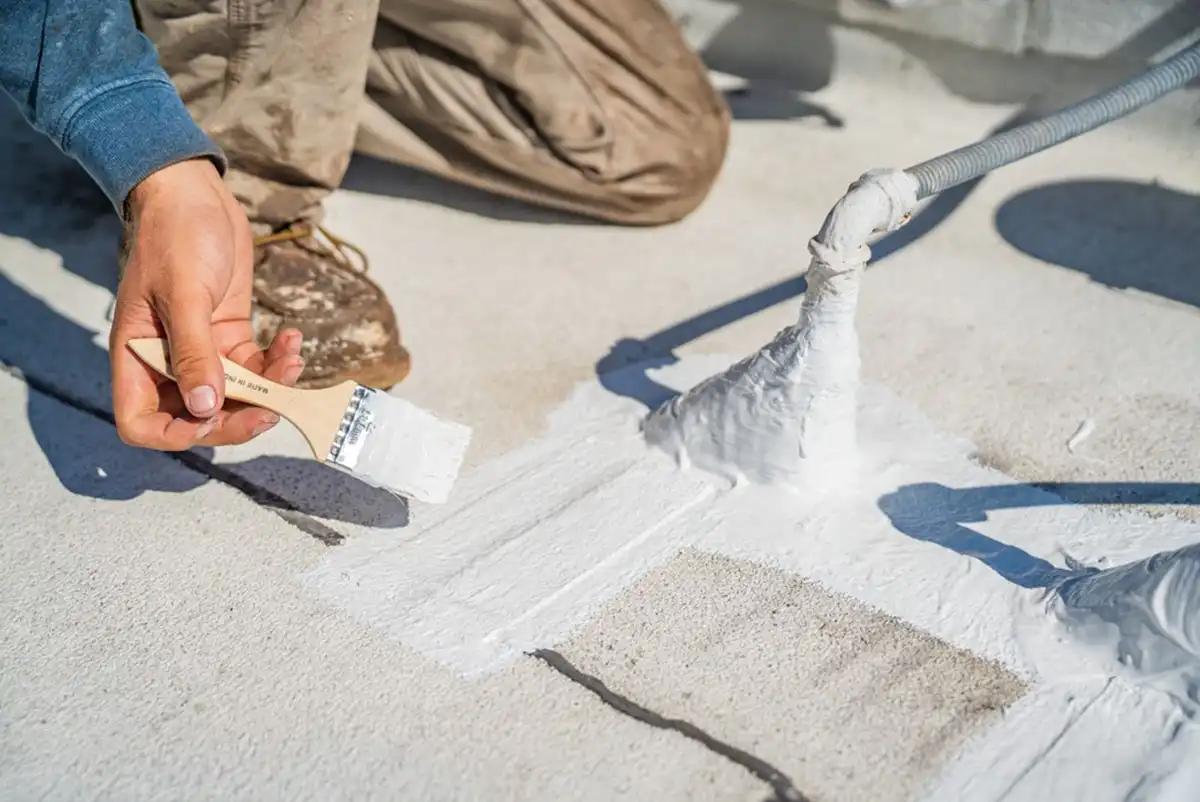
Every penetration through a commercial roof — HVAC curbs, plumbing vents, skylights, conduit, and drains — requires flashing to create a watertight seal between the penetration and the membrane. Over time, sealants crack, metal flashings lift, and expansion joints open. During heavy or sustained rainfall, water follows the path of least resistance and enters at these points. Because the damage is often slow and diffuse, it may not produce a visible interior leak for months.
2. Parapet Wall Caps and Termination Points
Where roofing membranes terminate at parapet walls, counter-flashings, and edge metal, the connection between the vertical and horizontal elements of the roofing system is under constant stress. Wind-driven rain during winter storms can force water up and behind termination points that appear intact from the surface. Once water is behind the membrane at a parapet, it typically saturates the wall assembly and is nearly impossible to detect without moisture testing.
3. Field Seams and Lap Joints
On torch-applied modified bitumen and single-ply systems like TPO and EPDM, the seams where membrane sections overlap are critical. Thermal cycling — the expansion and contraction of roofing materials as temperatures change — stresses these seams over time. Winter’s alternating warm and cool days accelerate this process. Seams that appear intact may have microscopic openings that allow capillary infiltration during extended rain events.
4. Drain and Scupper Areas
Flat roofs depend entirely on their drainage systems to remove water. When drains slow or become partially blocked by winter debris, bird nesting material, or sediment, water ponds for extended periods. Even brief ponding at drain sumps can stress the membrane in these areas. The cumulative effect of multiple rain events ponding in the same location accelerates membrane wear and, eventually, infiltration at the drain flange or the surrounding membrane.
5. Blisters and Bubbles Formed by Trapped Moisture
Blistering in a roofing membrane is caused by moisture or air trapped between layers of the roofing system. Winter rain events — particularly when temperatures fluctuate — can introduce moisture into the roofing assembly that then vaporizes during warmer days, forcing its way between layers and creating blisters. Small blisters look cosmetic. Left unaddressed, they grow, weaken the membrane, and eventually rupture — creating an open entry point for the next rain event.
Why Summer Heat Makes Winter Damage Worse
If winter rain is the initial trigger, summer heat is the accelerant. Here’s what happens when moisture-compromised roofing assemblies are exposed to Southern California’s summer temperatures:
- Saturated insulation loses R-value, driving up cooling costs inside the building.
- Trapped moisture vaporizes rapidly, expanding blisters and stressing seams and flashings.
- UV radiation degrades already-compromised membrane sections at a faster rate.
- Thermal movement is more extreme, opening seam failures and flashing gaps through which winter rain infiltrates.
What a post-winter inspection might identify as a manageable repair can become a significant failure point by mid-July. By the time the next rain season arrives in the fall, the roof that “had no leaks all winter” is now actively leaking in multiple locations.
How Moisture Testing Finds What Visual Inspections Miss
The most effective tool for identifying winter moisture damage that hasn’t yet produced a visible leak is infrared thermography. This non-invasive testing method uses thermal imaging to identify areas where wet insulation retains heat differently than dry insulation — making moisture intrusion visible without any destructive investigation.
Infrared surveys are typically performed in the evening after a sunny day, when the temperature differential between wet and dry insulation is most pronounced. The result is a moisture map of the entire roofing system that shows exactly where water has infiltrated — information that allows contractors to make targeted, cost-effective repairs rather than speculative patches.
For large commercial properties, infrared moisture surveys are one of the best investments a property owner can make after a wet winter. The cost of the survey is almost always recovered many times over in avoided repairs.
The Right Time to Act Is Now
Spring — specifically the period between the end of the wet season and the onset of summer heat — is the optimal window for identifying and repairing winter moisture damage. Roofing materials are workable, temperatures are moderate, and the full extent of winter damage is visible before heat begins to mask or accelerate it.
Waiting until fall, when the rainy season returns, eliminates this window entirely. Repairs become more urgent, more expensive, and more disruptive. Emergency repairs during active rain events are never ideal — for the contractor, the building, or the budget.
The property owners who manage roofing costs most effectively over time are those who inspect proactively in spring, address what they find before summer, and enter the next rain season with a roofing system that’s been documented and maintained. It’s a simple cycle — but it requires acting before there’s an obvious problem.
Reach out to SBR Roofing today for a post-winter roof inspection and moisture assessment.
About the Author
Dan Cahill embarked on his journey in 2001, accumulating over 23 years of experience in the commercial roofing field. The original owner of SBR Roofing extended a trial opportunity in 2001, coinciding with the burst of the dot-com bubble. The proposition was simple: give it a year, see if it suits you, and if not, no hard feelings. Surprisingly, Dan found himself sticking around. Fast-forward over two decades, and he continues to thrive in the field.
With a background in sales, Dan discovered a passion for the dynamics of salesmanship, particularly in the freedom it offered from the confines of a desk. The opportunity to engage with people, navigate various situations, and even climb up on roofs appealed to him. This intriguing experience kept Dan hooked, prompting him to stay the course and eventually become a leader in the roofing industry.